
Listen to Part 2 of the Quarterly Letter
Executive Summary
Some institutional investors who had grown accustomed to outperforming the broader private equity composites are finding they have not done so consistently in recent years. Their diagnoses of the problem often center on specific decisions or biases they made in their recent manager selection, whereas a likely culprit is a falloff in the persistence of outperformance among private equity managers.
While wide performance dispersion persists among private equity funds of a given vintage, academic research suggests that the tendency for a manager’s prior strong performance to persist into subsequent funds has largely disappeared, particularly when prior performance is based on the interim measures used to compare funds less than 10–15 years old. If this lack of persistence is the “new normal,” it will be very difficult for investors to expect to outperform the private equity composites by meaningful amounts going forward.
Investment committees should encourage institutions to raise the bar for hiring private equity managers, as putting money to work relatively cheaply in the public markets is a better investment than paying high fees for private equity managers they have less than full confidence in.
Read Part 1 of the Quarterly Letter, What Barbarians Like to Take Private (Or: The Risks in Your Private Equity Portfolio), in which Ben Inker and John Pease use decades of buyout data to demonstrate how private equity portfolios are becoming ever more concentrated on a small set of risks.
My day job at GMO does not directly involve private equity beyond being an observer. But I do wind up discussing private equity reasonably regularly, both with investment committees that I serve on and when invited to speak to the investment committees of other institutions. And in those situations, I’ve started to notice something a little jarring that may not be as obvious to investment committee members who only experience the performance of one or two institutions.
It is well known that private equity has failed to keep up with the public markets over the last several years. But I also seem to be hearing from a number of institutions that the performance of their particular PE portfolio, which in the past might have done substantially better than the Preqin, Cambridge Associates, or other composite, no longer seems to be doing so. There is usually an excuse that feels specific to the institution in question—“we focused too much on co-investment opportunities and failed to keep a high enough bar on our expectations for the actual fund performance,” or “we were too slow to react to our GPs’ loss of focus and mission creep.”
The implication of those explanations is that fixing a particular problem they diagnose will lead to better relative performance in the future. But there is another explanation for this phenomenon that is less fixable and feels awfully plausible to me: if the persistence of performance for PE managers has gone away, or even significantly deteriorated, the performance difference between the best institutional PE portfolios and the mean is doomed to collapse to low levels. 1 For private equity allocations predicated on a belief in the investment staff’s ability to find and secure the very best private equity managers, such an explanation would call into question the rationale for the allocation in the first place.
The original handbook for the endowment model, David Swensen’s Pioneering Portfolio Management (2009), made no claims about an inherent return premium for private equity. While Swensen acknowledged some advantages of private equity in principle—better alignment with investors, longer time horizons, the focus on operating efficiency that comes along with a greater debt load—he pointed out that private equity also suffers from high fees, principal-agent problems, and the tendency for successful managers to raise ever-larger funds only for them to underperform their earlier, smaller ones.
He concluded that private equity was riskier than public equities due to its high leverage and, to the best of his knowledge, achieved disappointing median returns over its history (pp. 220–235). 2 The case for private equity, rather than resting on some vague “illiquidity premium,” 3 was all about finding extraordinary managers. He believed private assets were a good place to do that, given their much wider range of performance across managers relative to public equities or fixed income.
In practice, generating this alpha for an institution would involve finding extraordinary portfolio managers or firms who can consistently outperform their peers. So the first question any investment committee should ask when discussing an allocation to private equity or any other private asset is: what makes us confident we can find these extraordinary managers and get meaningful allocations to their funds?
If the committee can’t credibly answer that question, it makes little sense for them to try to replicate the asset allocation of institutions that can. But even for institutions that have reason to claim such a selection ability, private equity fund performance really needs to be significantly persistent for the game to work. And it is far from clear that such persistence exists.
Several academics have done interesting work on the topic, noting that persistence of performance has fallen notably since 2000, and more so for private equity than venture capital. 4 A particularly relevant finding is that the interim performance of funds that have not completed their life cycles is entirely unhelpful in predicting future fund returns, a real problem since those are the only returns recent enough to feel relevant when considering a manager’s next fund.
While we all know “past performance is not indicative of future results,” it is extremely hard to overstate how central past performance is to investors' decision-making when choosing private asset managers. You are buying into a blind pool, and almost the only thing you know is what the manager did in the past.
While the performance of the investments in that previous pool is not the only thing you can analyze, it feels like the most salient piece of data there is. But what if that is an illusion? A mature private equity portfolio will consist of multiple funds from multiple managers, so the total number of different funds owned by an institution will generally be pretty large, easily a couple of dozen or more, even if the institution has relationships with a relatively small number of firms.
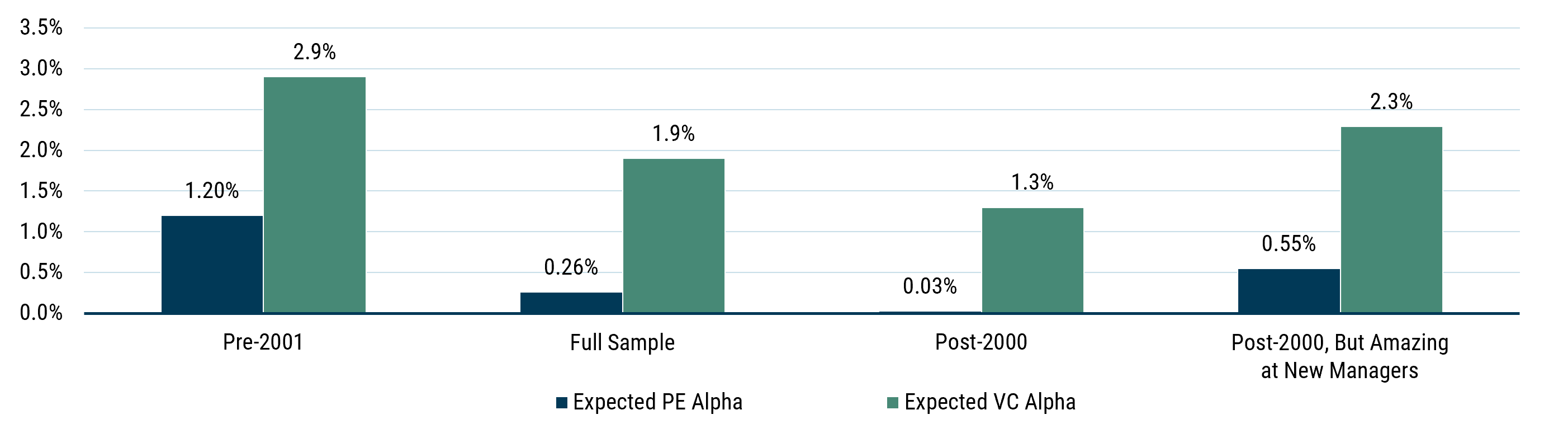
If there truly is little persistence in private equity fund returns, it implies that even if the range of returns between the best- and worst-performing funds remains large, the aggregate returns for an institution will almost always be close to the median. The chart below shows the implied alpha of a diversified PE portfolio across several levels of performance persistence (Braun, Jenkinson, and Stoff 2017).
Effect of Performance Persistence on Expected PE and VC Alpha
Source: Braun, Jenkinson, and Stoff (2017)
Assumed alpha for quartiles of performance is 8%/3.5%/-3.5%/-8% for PE and 12%/4%/-4%/-12% for VC. “Amazing at New Managers” assumption is 40%/30%/20%/10% odds of new managers being in each alpha quartile, and 20% of assets in PE/VC invested in such new managers.
I’ve put the venture capital results in as well. While there was basically no evidence of persistent performance in the post-2000 sample for private equity, venture capital did show a decent amount of persistence, even if it, too, shows substantially less persistence than the early sample. I added a fourth column in which I made a friendly assumption about the new funds that an institution hires. I assumed that the institution had an amazing record in backing new managers, and that those new managers had a 40%/30%/20%/10% chance of being in the 1st through 4th quartiles of performance.
I further made the (probably insanely friendly) assumption that the institution’s full 20% PE or VC allocation was invested in such funds (such an institution could still not expect very much alpha from a PE portfolio, though 55 basis points is a whole lot better than the 3 basis points of implied alpha for an institution that simply reupped with its strongest performers).
It’s possible I’m being unfair in assuming that the basic due diligence in choosing to invest in the new funds of current managers is to look at the interim performance of their previous funds, but for institutions whose current alpha relative to the PE composite does not look particularly impressive, I think it’s fair to ask why you think it will get better in the future.
I’m not trying to make the case that institutions should abandon private equity. Actually, if one believes, as I do, that private equity is choosing from a small, junky group of firms, the industry's performance has been somewhat better than it looks over the last decade. 5 I also believe that investing skill exists, 6 and that it makes sense for well-resourced institutions to invest with private equity managers they truly have high conviction in. The difference between the best and worst performers among private equity funds remains large, and an institution that can truly tilt the odds in favor of top-quartile results will reap substantial benefits.
But the bar to invest in a private equity manager should be high—arguably even higher than it is for active public asset managers, since you’ll be stuck paying PE managers high fees for a long time, even if you lose conviction in the interim. And if individual fund allocations truly do have a high bar, a target PE allocation may not even make sense (at least not beyond establishing an upper limit).
If, for example, you target 25% of your portfolio in U.S. public equities and can only come up with 10% worth of allocations to active managers you truly believe in, you have the option to allocate the other 15% passively. That passive option is not available to you in private equity. If you max out on high-caliber PE managers short of an overall allocation target, you will wind up investing the rest of your allocation in managers you have less confidence in. Paying high fees to managers you have less confidence in is unlikely to be a good use of capital.
How can the investment committee help? I think a good start would be for the investment committee to ask the investment staff to discuss their beliefs about each asset class in which the institution invests, the purpose each serves in the portfolio, how much (if any) alpha they expect to add in each asset class, and, crucially, how they intend to test those beliefs over time. They should document their beliefs for each asset class and compare them periodically, perhaps every three to five years. 7
At the end of the day, the role of the investment committee is to help the investment staff do a better job managing the portfolio. That should not be about second-guessing individual manager decisions, but pushing the investment staff to think critically about what they do and why is absolutely in the committee’s wheelhouse. Private equity programs are not meant to run on autopilot; there are critical questions to answer and, for many institutions, disappointing results to grapple with.
Read Part 1 of the Quarterly Letter: What Barbarians Like to Take Private
There will still be a fair bit of performance dispersion, since most investors invest with a relatively small number of PE managers, and there will still be plenty of variability in actual fund returns. But without persistence of returns, that variability will wind up mostly owing to chance, and longer-term returns will tend to converge.
Paraphrased from the 2009 edition, which made basically the same points as the original 2000 edition (pp. 224–233) with some updated data.
An illiquidity premium for leveraged buyouts (LBOs), at least, never made any sense in the first place. If you voluntarily take a public company private and pay a premium to do so, there is no plausible mechanism by which you could possibly get paid for taking on the illiquidity. The illiquidity might be a means to an end for some other mechanism to achieve higher returns, but the idea that you would generally get paid for the fact that the asset is no longer liquid is just silly when the illiquidity is entirely self-imposed.
I’m not going to pretend to give a comprehensive listing of the research, but a couple of studies that stood out to me included Braun, Jenkinson, and Stoff (2017), which looked at performance by deal rather than by fund, helping to abstract away from some of the fund return calculation problems; and Harris, Jenkinson, Kaplan, and Stucke (2023), which looked at the problem of interim performance calculations that investors are forced to rely on given the long lives of funds.
See part 1, What Barbarians Like to Take Private, for evidence of a small, low-quality bias in private equity.
Admittedly, I’m highly likely to be biased toward such a belief.
The risk in doing this is that it just turns into a referendum on which assets have done well or badly in the trailing period, which would be a profound mistake. There is already too much performance chasing in the investment world. But putting your beliefs down on paper is extremely important to avoid the narrative creep that it is all too easy to fall into. If ”private real estate is a great place to add alpha” turns into “private real estate is an inflation hedge,” then into “private real estate is an under-owned asset class,” and so on—each rationale replacing the last as the thesis fails to play out—while the target allocation remains fairly static, something has gone very wrong.
References
Braun, R., Jenkinson, T., & Stoff, I. (2017). How persistent is private equity performance? Evidence from deal level data. Journal of Financial Economics, 123 (2), 273–291.
https://doi.org/10.1016/j.jfineco.2016.01.033
Harris, R.S., Jenkinson, T., Kaplan, S.N., & Stucke, R. (2023). Has persistence persisted in private equity? Evidence from buyout and venture capital funds. Journal of Corporate Finance, 81 (102361).
https://doi.org/10.1016/j.jcorpfin.2023.102361
Swensen, D. (2009). Pioneering Portfolio Management: An Unconventional Approach to Institutional Investment, Fully Revised and Updated. Free Press.
Disclaimer: The views expressed are the views of Ben Inker through the period ending May 2026 and are subject to change at any time based on market and other conditions. This is not an offer or solicitation for the purchase or sale of any security and should not be construed as such. References to specific securities and issuers are for illustrative purposes only and are not intended to be, and should not be interpreted as, recommendations to purchase or sell such securities.
Copyright © 2026 by GMO LLC. All rights reserved.
There will still be a fair bit of performance dispersion, since most investors invest with a relatively small number of PE managers, and there will still be plenty of variability in actual fund returns. But without persistence of returns, that variability will wind up mostly owing to chance, and longer-term returns will tend to converge.
Paraphrased from the 2009 edition, which made basically the same points as the original 2000 edition (pp. 224–233) with some updated data.
An illiquidity premium for leveraged buyouts (LBOs), at least, never made any sense in the first place. If you voluntarily take a public company private and pay a premium to do so, there is no plausible mechanism by which you could possibly get paid for taking on the illiquidity. The illiquidity might be a means to an end for some other mechanism to achieve higher returns, but the idea that you would generally get paid for the fact that the asset is no longer liquid is just silly when the illiquidity is entirely self-imposed.
I’m not going to pretend to give a comprehensive listing of the research, but a couple of studies that stood out to me included Braun, Jenkinson, and Stoff (2017), which looked at performance by deal rather than by fund, helping to abstract away from some of the fund return calculation problems; and Harris, Jenkinson, Kaplan, and Stucke (2023), which looked at the problem of interim performance calculations that investors are forced to rely on given the long lives of funds.
See part 1, What Barbarians Like to Take Private, for evidence of a small, low-quality bias in private equity.
Admittedly, I’m highly likely to be biased toward such a belief.
The risk in doing this is that it just turns into a referendum on which assets have done well or badly in the trailing period, which would be a profound mistake. There is already too much performance chasing in the investment world. But putting your beliefs down on paper is extremely important to avoid the narrative creep that it is all too easy to fall into. If ”private real estate is a great place to add alpha” turns into “private real estate is an inflation hedge,” then into “private real estate is an under-owned asset class,” and so on—each rationale replacing the last as the thesis fails to play out—while the target allocation remains fairly static, something has gone very wrong.