
Listen to this Insight
In quarterly client letters, GMO's Usonian Japan Equity team shares its long-term outlook. Recent letters have explored Japan’s corporate governance reform through capital allocation, corporate control, and engaged ownership. This excerpt builds on those themes, examining growing expectations for boards to explain their capital decisions. Given its timeliness, we are sharing it as a standalone piece.
Please contact your GCR representative for access to the full quarterly client letter or to learn more about Usonian Japan Equity strategies.
The Disclosure Front of Japan's Governance Reform
Over the past two quarters, we have described Japan’s governance reform as advancing on more than one front: first, the revised Corporate Governance Code’s push for boards to justify how they deploy balance-sheet resources; second, the contest over changes of control, where outcomes increasingly turn on whether an investor has earned a seat at the table. 1 Over recent months, these strands have converged. The revised Corporate Governance Code has been finalized, the Ministry of Economy, Trade and Industry (METI) has issued guidance on growth investment, the Tokyo Stock Exchange (TSE) has adopted minority-protection rules that apply from fiscal years ending December 2026, and the Ministry of Justice has circulated draft amendments to the Companies Act. The reform agenda now treats growth investment as a primary use of capital and asks boards to show that capital earns more than it costs. At the same time, some shareholder tools have been limited, while others are under discussion. Read quickly, this looks like a retreat. We think a more accurate reading is that the source of pressure on boards is changing. For much of the past decade, pressure came largely from shareholders forcing the issue through activist campaigns, proposals, and votes. Going forward, we expect boards to feel more pressure from increasing disclosure requirements and the scrutiny that will follow. Boards are asked to explain publicly, in their own words, where capital goes and why, and controlled companies will have to disclose and respond to minority opposition. Investors can then test those explanations in dialogue with management and independent directors and, ultimately, through their votes. The tools to compel a board are narrowing; the expectation that it explains itself is widening.
Growth Becomes the Use of Capital, and Economic Profit the Test
The revised Corporate Governance Code asks boards to set out “a path for growth,” including investment in capital expenditure, R&D, human capital, and intangible assets, and review of the business portfolio. METI’s diagnosis is that Japanese companies underinvest: by its measure, growth investment runs at 17.7% of sales, roughly half the level in the United States and Europe (METI 2026a). The first phase of reform began returning excess capital through buybacks and dividends, though much of that excess capital remains on balance sheets. What has changed is where that capital is now likely to go.
Emphasis is also moving from return on equity toward economic profit: whether each business earns more than its cost of capital. METI estimates that roughly 65% of Japanese corporate assets sit in segments that destroy value, compared with 39% in the United States and 42% in Europe. 2 On this reading, the instruction to grow and the instruction to exit are the same: move capital from areas that destroy value into areas that create it. METI's analysis puts an official spotlight on what we have long pursued in engagement: exiting non-core, value-destroying businesses so management can focus on its core strengths. In that sense, the latest reforms give engaged owners another useful tool.
VALUE-CREATING AND VALUE-DESTRUCTIVE SEGMENTS AMONG MAJOR COMPANIES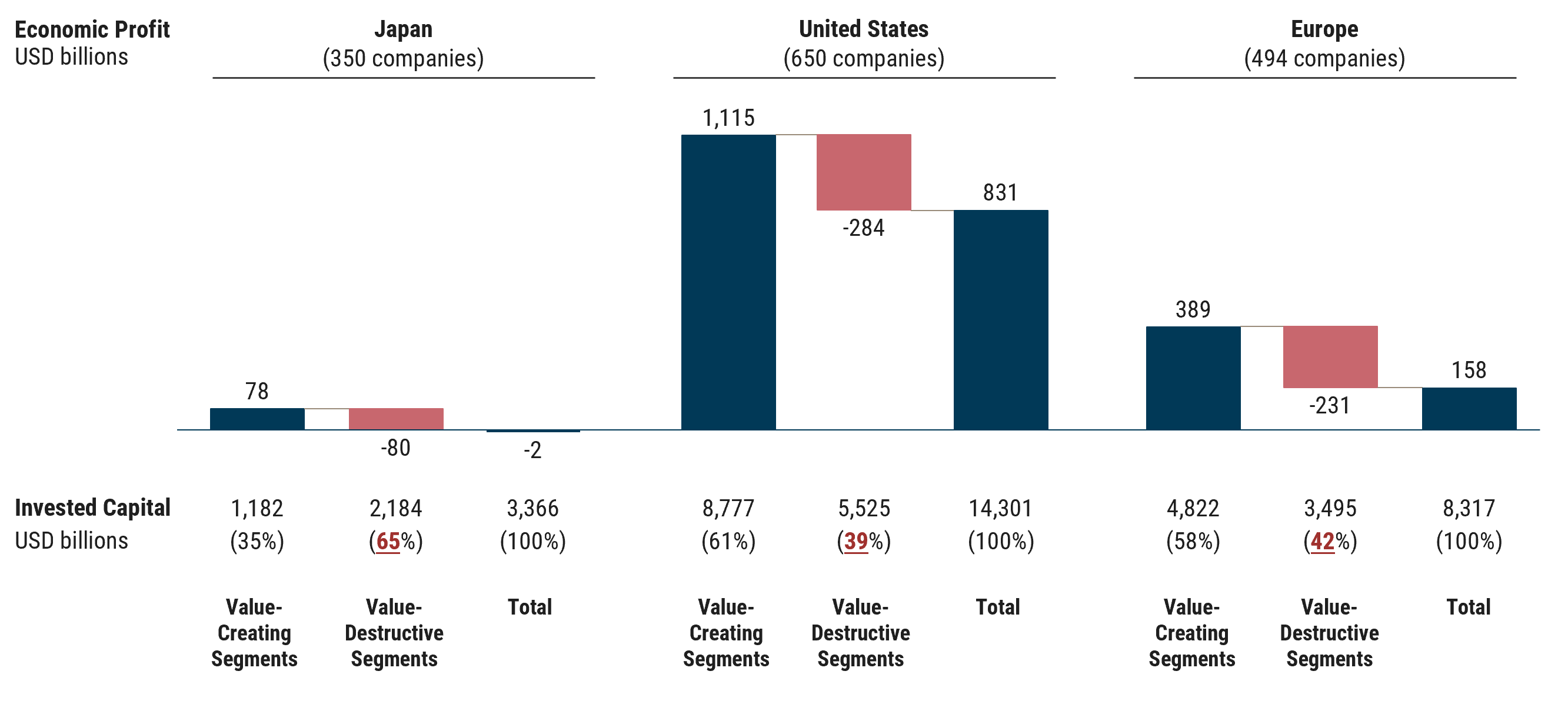
As of 2024 | Source: METI, based on the “McKinsey Commissioned Study.” 3
We support the aim, but long experience in Japan has shown us how readily capital can be misallocated. “Growth investment” can describe a disciplined expansion or an empire-building acquisition, and segment returns depend on assumptions that management controls. The Corporate Governance Code was also streamlined, moving many requirements outside the comply-or-explain edict. 4 Poorly priced acquisitions could become more common, which argues for both selectivity and having an open dialogue with management.
Some Shareholder Tools Limited, Others Pending
One shareholder tool has already been limited: cash-settled equity swaps now count toward large-shareholding disclosure rules. Others are under discussion. The Ministry of Justice is considering changes to the 300-voting-unit route for shareholder proposals, limits on proposals to amend the articles, and a mechanism to suspend voting rights when a large shareholding report is missing or materially wrong. The government and ruling party have also proposed raising the threshold to call an extraordinary meeting from 3% to 5%, and in July, the ruling party warned against undisclosed "wolf-pack" coordination. None of these proposals is law. A bill is not expected before the 2027 ordinary Diet session, and the final form may differ materially (FSA 2026; MOJ 2026; Mori 2026 5 ; Yamazaki and Uranaka 2026).
If these proposals become law, they would matter. In Japan, shareholders cannot submit nonbinding proposals to a vote; instead, the main tool available to them is a proposal to amend the company's articles of incorporation. Limiting those proposals would therefore materially restrict a shareholder’s ability to communicate with other shareholders and collectively pressure boards to make changes. The proposed vote suspension would also raise the stakes of existing rules. Investors who agree to act together must already report their combined holdings as a group; under the proposal, a missing or wrong report by one could cost the group their votes. Our larger concern is how the rule might be applied: a company could seek to disqualify a dissenting shareholder’s votes over a reporting error that is often outside that shareholder’s control, such as an administrative mistake in the custodial chain.
Elsewhere, the balance is mixed. On one side, boards have gained room to resist unwanted bids. METI's July Q&A on its takeover guidelines confirms that a high price alone does not make a bid desirable and that a board may favor the proposal it considers most conducive to “corporate value,” though non-price factors count only where they can reasonably be expected to raise future cash flows and should not be used to protect management. Takeover defenses have also become more common. On the other side, in September, the Tokyo District Court blocked Toho Holdings' poison pill as aimed at entrenching management, despite earlier shareholder approval; the ruling is subject to appeal (Homma 2026). 6 And new TSE rules will require companies with a controlling or major shareholder to disclose how minority shareholders voted on each director and, where a majority opposes, to respond publicly.
What Engaged Owners Have Gained
What is being removed is largely procedural: ways for a small stake to compel a board without persuading it. What is being added is the expectation that boards address, in public, the same questions engaged owners have long asked: how they plan to grow, how they set capital policy, and why they hold cash. Under the revised Corporate Governance Code, which operates on a comply-or-explain basis rather than as law, boards are asked to explain their path to growth, capital policy, and reasons for holding cash; much of the detail is set out in guidance and left to management's discretion. The TSE also expects outside directors, whom it describes as representing the interests of ordinary shareholders, to engage directly with investors where concerns arise and to make sure the board discusses their feedback (FSA and TSE 2026; TSE 2026).
Equally important, the Financial Services Agency rewrote the tests for when investors are treated as acting jointly so that substantive dialogue, including among investors, does not by itself make them joint holders. The contrast with the United States, where regulators have recently warned that coordinated engagement could cost asset managers their passive status, is instructive (SEC 2026; The White House 2025). Whatever its other limits, Japan’s framework now leans toward dialogue. None of this compels a determined board, but it raises the cost of stonewalling: a board that departs from the Corporate Governance Code is expected to explain why, and an informed owner can show where that explanation falls short.
Where the Value Now Lies
The first phase of reform produced value available to almost any shareholder: buybacks, dividend increases, and cross-shareholding sales. What remains—including reshaping business portfolios, separating non-core divisions, resolving parent-subsidiary listings, and setting the terms of control transactions—is multi-year, information-intensive, and dependent on trust. Our own engagement has moved in the same direction: strategy, portfolio, and control questions have risen from roughly 10% of our engagement actions in 2021 to 32% in 2026 to date. 7
This environment rewards ownership large enough and long enough to earn standing with a board, analysis deep enough to engage on segment economics, and patience. Leverage that comes from procedure is being repriced; influence that comes from standing, the quality of the analysis, and the credibility of the relationship is not. Boards are increasingly expected to explain their capital decisions, and engaged owners are well placed to test those explanations.
Outlook
We remain constructive on the medium- to long-term outlook for Japanese equities. Earnings are strong, shareholder returns continue to rise, and reform continues to broaden. As boards are asked to explain how their capital earns its cost, we expect greater dispersion within the universe of overcapitalized value stocks between companies that put their balance sheets to productive use and those that invest poorly or not at all. That dispersion is where we expect stock selection and engagement to matter most.
The path is unlikely to be smooth. Real wages turned negative again in August, foreign investors were net sellers late in the quarter, and relations with China deteriorated at quarter-end. Further rate increases would also raise the cost of capital and, with it, the return hurdle that new investments must clear just as many companies are beginning to put their balance sheets to work. As companies invest more in growth alongside rising shareholder returns, being selective and engaging before making large commitments matter more than ever. Several of the reforms discussed above are also still pending, and their final form is not yet known.
References
ACGA (Asian Corporate Governance Association). 2026. “ACGA Response to Proposed Japan Corporate Governance Code Revisions.” Advocacy. May 15.
FSA (Financial Services Agency). 2026. Amendments to the large shareholding reporting rules under the 2024 FIEA amendments, effective May 1. https://www.fsa.go.jp/en/refer/councils/stewardship/20250917/01.pdf
FSA and TSE (Tokyo Stock Exchange). 2026. "Finalization of the Corporate Governance Code (2026 Revision)." July 21. https://www.fsa.go.jp/en/news/2026/20260721-2.html
Homma, Yasutake. 2026. Research note. Bloomberg Intelligence, September 22.
Keidanren. 2025. “Toward Corporate Governance Reform for Sustainable Growth.” December 16. https://www.keidanren.or.jp/en/policy/2025/083.html
METI (Ministry of Economy, Trade and Industry). 2026a. “Publication of the Guidance for Growth Investment.” July 21. https://www.meti.go.jp/english/press/2026/07/20260721001.html
METI. 2026b. "METI Formulates Key Points and Q&A on the Guidelines for Corporate Takeovers." July 30. https://www.meti.go.jp/english/press/2026/07/20260730002.html
MOJ (Ministry of Justice), Legislative Council. 2026. “Interim Proposal on the Review of the Companies Act (Regarding Shares, Shareholders Meetings, etc.).” March 18. https://www.moj.go.jp/content/001461124.pdf
Mori, Mikiharu. 2026. “Requirements for Requesting Extraordinary Shareholder Meetings to Tighten, Voting Rights from 3% to 5% or More: Government/LDP Policy.” Nikkei, July 16. https://www.nikkei.com/article/DGXZQOUA159IS0V10C26A7000000/
SEC (U.S. Securities and Exchange Commission). 2026. “Report of Investigation Pursuant to Section 21(a) of the Securities Exchange Act of 1934 Regarding Climate Action 100+ and the Election of Directors at the May 2021 Annual Meeting of ExxonMobil Corporation.” October 7. https://www.sec.gov/files/litigation/investreport/34-106611.pdf
TSE. 2026. Materials accompanying the revised Corporate Governance Code. July 3. https://www.jpx.co.jp/english/rules-participants/public-comment/detail/d1/vk0khi00000105to-att/vk0khi000001t0yd.pdf
The White House. 2025. Executive Order 14366, “Protecting American Investors from Foreign-Owned and Politically Motivated Proxy Advisors.” December 11. https://www.whitehouse.gov/presidential-actions/2025/12/protecting-american-investors-from-foreign-owned-and-politically-motivated-proxy-advisors/
Wood, Christopher. 2026. Research note. Jefferies, September 18.
Yamazaki, Makiko and Uranaka, Miho. 2026. “Japan’s Ruling Party Plans Tighter Oversight of Disclosures by Activist Investors.” Reuters, July 8. https://www.reuters.com/legal/government/japans-ruling-party-plans-tighter-oversight-disclosures-by-activist-investors-2026-07-08/
See Policy Tug-of-War: Japan's Evolving Market for Corporate Control (Bekemeyer and Edwards 2026).
Segment economic profit compares segment return on invested capital with the cost of capital.
Sample Selection: Companies among the top 3,000 global companies by revenue in 2024 for which Economic Profit (EP) data are available for the entire observation period (2009–2024), excluding banks, REITs, and similar entities. Segment Classification: Segments with segment EP ≥ 0 are defined as Value-Creating Segments, while segments with segment EP < 0 are defined as Value-Destructive Segments. Company-wide NOPAT and invested capital are allocated to segments based on the composition of segment profits and assets. Segment EP is calculated as: Segment EP = Segment NOPAT – (Company-wide WACC × Segment Invested Capital). Where profit or asset data are unavailable, allocation is based on the composition of segment revenue. Segments with zero or missing revenue, or segments whose names contain “Adjustment,” “Intersegment,” “Elimination,” “Intercompany,” or “Reconciliation” are excluded from the analysis. Because intersegment adjustments are excluded, the sum of the Value-Creating Segments and Value-Destructive Segments for an individual company does not necessarily equal the company-wide figures. Companies without segment data are excluded from the analysis. In Europe, PGE Polska Grupa Energetyczna S.A. (Poland) and Bayer Aktiengesellschaft (Germany) are excluded as outliers. Graphics recreated by GMO based on METI's "Guidance for Growth Investment," accessed August 2026.
From roughly 83 items to about 30 (FSA and TSE 2026). Investor groups have criticized the change (ACGA 2026); Keidanren has argued for a minimized Code (Keidanren 2025).
Plan only; no bill drafted.
Toho Holdings Co., Ltd.; injunction dated September 18, 2026.
The Usonian Engagement and Impact Database recorded 619 engagement actions from January 2021 to September 2026, excluding standardized mass mailings.
Disclaimer: The views expressed are the views of Drew Edwards and Colin Bekemeyer through the period ending November 2026 and are subject to change at any time based on market and other conditions. This is not an offer or solicitation for the purchase or sale of any security and should not be construed as such. References to specific securities and issuers are for illustrative purposes only and are not intended to be, and should not be interpreted as, recommendations to purchase or sell such securities. Copyright © 2026 by GMO LLC. All rights reserved.
See Policy Tug-of-War: Japan's Evolving Market for Corporate Control (Bekemeyer and Edwards 2026).
Segment economic profit compares segment return on invested capital with the cost of capital.
Sample Selection: Companies among the top 3,000 global companies by revenue in 2024 for which Economic Profit (EP) data are available for the entire observation period (2009–2024), excluding banks, REITs, and similar entities. Segment Classification: Segments with segment EP ≥ 0 are defined as Value-Creating Segments, while segments with segment EP < 0 are defined as Value-Destructive Segments. Company-wide NOPAT and invested capital are allocated to segments based on the composition of segment profits and assets. Segment EP is calculated as: Segment EP = Segment NOPAT – (Company-wide WACC × Segment Invested Capital). Where profit or asset data are unavailable, allocation is based on the composition of segment revenue. Segments with zero or missing revenue, or segments whose names contain “Adjustment,” “Intersegment,” “Elimination,” “Intercompany,” or “Reconciliation” are excluded from the analysis. Because intersegment adjustments are excluded, the sum of the Value-Creating Segments and Value-Destructive Segments for an individual company does not necessarily equal the company-wide figures. Companies without segment data are excluded from the analysis. In Europe, PGE Polska Grupa Energetyczna S.A. (Poland) and Bayer Aktiengesellschaft (Germany) are excluded as outliers. Graphics recreated by GMO based on METI's "Guidance for Growth Investment," accessed August 2026.
From roughly 83 items to about 30 (FSA and TSE 2026). Investor groups have criticized the change (ACGA 2026); Keidanren has argued for a minimized Code (Keidanren 2025).
Plan only; no bill drafted.
Toho Holdings Co., Ltd.; injunction dated September 18, 2026.
The Usonian Engagement and Impact Database recorded 619 engagement actions from January 2021 to September 2026, excluding standardized mass mailings.