An actively managed American reindustrialization ETF seeking exposure to companies that may benefit from the rebuilding of U.S. industrial capacity, with a focus on domestic revenue and valuation discipline.
Tariffs and trade policy, reshoring, and industrial strategy are reshaping the U.S. economy. For investors, the question is how to position for it and invest amid deglobalization.
The GMO Domestic Resilience ETF (NYSE: DRES) is an actively managed fund designed to provide focused exposure to the emerging U.S. industrial renaissance and the long-term structural forces bringing manufacturing back to America through a disciplined, bottom-up investment approach.
A structural shift is underway in the U.S. economy
After decades of offshoring, a convergence of policy action, corporate strategy, and geopolitical reality is accelerating the active reshoring of industrial production to the United States.
Policy support: CHIPS Act, Inflation Reduction Act, and infrastructure spending, supported by both political parties
Corporate investment: Large-scale onshoring of manufacturing capacity
Supply chain reshoring: Increasing supply chain resilience by reducing global dependencies as vulnerabilities and rising geopolitical tensions persist
This U.S. industrial renaissance isn't a trade of the moment — it is a multi-year repositioning of the U.S. industrial base, which GMO believes could create investment opportunities in the companies building the backbone of the U.S. economy.
What is the GMO Domestic Resilience ETF (DRES)
An American reindustrialization ETF with a differentiated approach
The GMO Domestic Resilience ETF is an actively managed, focused portfolio of U.S. equities designed to identify and invest in companies we believe will benefit from the shift away from globalization and the anticipated acceleration of onshoring vital technologies and industries, while also applying GMO's longtime views on the importance of company quality and valuation.
Unlike passive thematic indexes and ETFs, DRES is actively managed. Every holding is selected through fundamental, bottom-up research evaluating profitability, balance sheet strength, earnings stability, and valuation.
Ticker
DRES
CUSIP
90139K860
Exchange
NYSE
Expense Ratio
0.50%
Inception Date
October 1, 2025
Number of Holdings*
~38
*As of 3/31/2026
DRES Investment Framework
Four pillars of domestic resilience guide portfolio construction
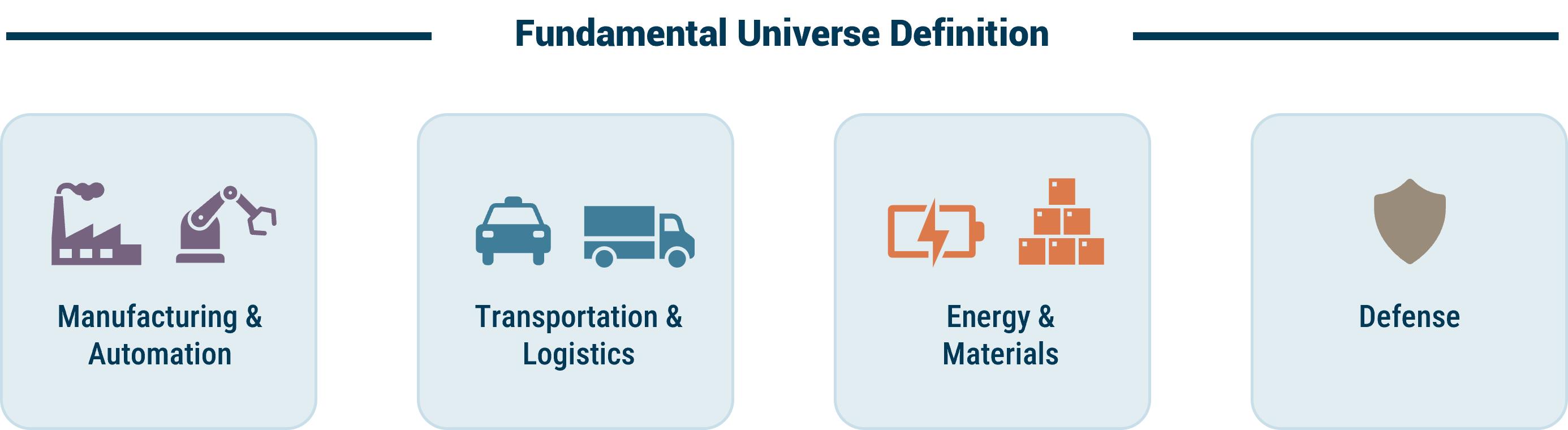
DRES invests across four interconnected areas that we believe underpin America's industrial economy. Each plays a critical role in the reindustrialization story, and each offers distinct investment opportunities for patient, fundamental investors.
Manufacturing & Automation
U.S. manufacturing is moving beyond the "just outsource it to Asia" era. Advances in robotics and automation are helping bridge labor gaps and making domestic production increasingly viable. We view these companies as the "picks and shovels" of reindustrialization — providing the essential inputs that enable building in America. This is DRES's largest investment category, encompassing a wide range of businesses driving the American industrial economy.
Reindustrialization increases the number of domestic shipping nodes, creating new demand for America's transportation infrastructure. From railroads to trucking, these companies move the raw materials and finished goods that a growing industrial base requires.
You can't build without the basics. Reshoring factories and rebuilding infrastructure starts with reliable energy supply and raw materials — from aggregates and steel to oil and gas. Local supply is often the only cost-effective solution, positioning domestic energy and materials companies as foundational beneficiaries.
U.S. military strength depends on some of the world's best defense companies. As global defense budgets surge and geopolitical tensions intensify, prime contractors with deep government partnerships stand to benefit from long-term spending commitments. Defense is a key force behind America's need to reindustrialize — and a critical pillar of domestic resilience.
The biggest winners of the AI revolution may not be in Silicon Valley. In Domestic Resilience, we're finding AI-related opportunities in traditional industrial companies that can benefit from the changes AI brings to their businesses — and in a subset of companies where fears of AI disruption appear overstated. The real opportunity lies in looking beyond the obvious.
The GMO Domestic Resilience ETF offers a compelling option.
1. Gain more direct exposure to the U.S. economy
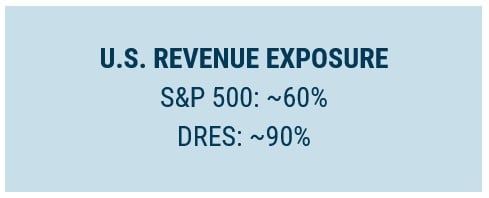
Broad equity indices derive a significant share of revenue from outside the U.S.
DRES is constructed differently.
As of 3/31/2026. Source: S&P, GMO
This makes DRES a more targeted domestic resilience ETF aligned with U.S. economic growth.
2. Active management matters
Some “American manufacturing stocks ETF” or “energy and materials ETF” products rely on passive exposure.
DRES takes a differentiated approach:
Bottom-up stock selection based on fundamentals
Focus on profitability and capital discipline
Emphasis on valuation, not thematic narratives
Concentrated, high-conviction portfolio
3. Not just a theme, but an investment discipline
While DRES captures exposure to American manufacturing stocks and industrial activity, inclusion is driven by company quality, not labels.
Each holding must meet strict fundamental criteria.
Go Deeper — The Resilience Rundown
Want to go beyond the headlines? Subscribe to The Resilience Rundown, a monthly newsletter where each issue takes a closer look at the sectors, companies, and investment themes that make up domestic resilience — straight from a portfolio manager's perspective.
Performance Snapshot
DRES has delivered positive returns since its inception in September 2025, driven by fundamental stock selection across the four pillars of domestic resilience. For more data and portfolio stats, visit the fund page.
Annualized Returns as of June 30, 2026 (Net, USD, %)
Inception
QTD
YTD
ITD
Domestic Resilience ETF NAV
9/30/2025
12.12
22.34
25.36
Domestic Resilience ETF Market Price
12.07
22.21
25.27
MSCI USA Mid Cap (Gross)
14.17
12.22
12.46
S&P 500
15.20
10.21
13.13
Performance data quoted represents past performance and is not indicative of future results. The investment return and principal value of an investment will fluctuate so that an investor’s shares, when redeemed, may be worth more or less than their original cost. Current performance data may be lower or higher than the performance data provided herein.
Exchange Traded Funds (ETFs) are bought and sold through exchange trading at market price (not NAV), and are not individually redeemed from the fund. Shares may trade at a premium or discount to their NAV in the secondary market. Brokerage commissions will reduce returns.
Meet the Managers
Sam Klar
Portfolio Manager
Mr. Klar is engaged in portfolio management and research within GMO’s Focused Equity team. Previously at GMO, he was a portfolio manager on the Event-Driven team, and prior to that, he was a member of the Global Equity team. Prior to joining GMO full-time in 2006, he held a co-op position at GMO with the Emerging Markets Equity team. Mr. Klar earned a bachelor's in Finance from Northeastern University.
Tom Hancock
Head of Focused Equity, Portfolio Manager
Dr. Hancock is the Head of GMO’s Focused Equity team and a portfolio manager for GMO’s Quality Strategies. Dr. Hancock is a partner of the firm. Previously at GMO, he was Co-Head of the Global Equity team. Prior to joining GMO in 1995, he was a research scientist at Siemens and a software engineer at IBM. Dr. Hancock holds BS and MS degrees from Rensselaer Polytechnic Institute and a PhD in Computer Science from Harvard University.
How to Invest in the GMO Domestic Resilience ETF
Access DRES through your existing investment platform
DRES trades on the NYSE just like a stock. You can buy shares through your investment platform, broker, or work with your financial advisor — no minimum investment required.
Where investors can find the ETF Search for ticker DRES on your brokerage, advisory, or investment platform to get started.
Talk to GMO Have questions about the fund or how it fits your portfolio? Contact us or email access@gmo.com.
An investor should consider the fund's investment objectives, risks, charges, and expenses before investing. This and other important information can be found in the fund's prospectus. To obtain a prospectus, please visit www.gmo.com. Read the prospectus carefully before investing.
Risks associated with investing in the Fund may include: (1) Focused Investment Risk: the Fund invests its assets in the securities of a limited number of issuers, and a decline in the market price of a particular security held by the Fund may affect the Fund's performance more than if the Fund invested in the securities of a larger number of issuers; (2) Market Risk — Equities: the market price of equities may decline due to factors affecting the issuer, its industries, or the economy and equity markets generally. Declines in stock market prices generally are likely to reduce the net asset value of the Fund's shares; and (3) Management and Operational Risk: the risk that GMO's investment techniques will fail to produce desired results. For a more complete discussion of these and other risks, please consult the Fund's Prospectus.
The portfolio is actively managed, is not managed relative to a benchmark and uses an index for performance comparison purposes only. There is no guarantee active management will produce better results than passive strategies.
The GMO ETFs are distributed in the United States by Foreside Fund Services LLC. GMO and Foreside Fund Services LLC are not affiliated.
Founded in 1977, GMO is a global investment manager committed to delivering superior long-term performance and advice to our clients.
Leaving GMO?
You are now leaving the GMO website and going to a website that is not operated by GMO. GMO is not responsible for the content on this website.