
Listen to this Insight
"Markets misprice businesses, but ultimately, economic reality prevails."
Many quantitative managers can describe a model; fewer can explain why it should keep working. At GMO, the answer begins with a cornerstone conviction: markets misprice businesses, but ultimately, economic reality prevails. For nearly 50 years, our research and portfolio construction have been built around that conviction. We started by capturing Jeremy Grantham’s valuation discipline with quantitative tools and have continued applying fundamental analysis at scale with research across multiple alpha dimensions.
We systematize fundamental investment judgments: the value of a business, how expectations are shifting, where asymmetric risks are hidden, and how country and industry forces are impacting companies. Every position traces back to a specific research insight. We call this a glass-box process: every position has an explicit investment thesis, not just a signal weight.
A different starting point
Systematic equity investing has converged around a familiar toolkit: value, momentum, quality, risk controls, and an optimizer. Our starting point is different; we focus on economic reality by restating fundamentals where accounting obscures value, building intrinsic-value models rather than relying on ratios, and continuously assessing how expectations are changing.
That starting point matters because investing through many market cycles has taught us where systematic processes tend to break down: generic factor exposures, fragile backtests, crowded risks, and false precision in portfolio construction. Our research exists to address each of those failure modes directly and to stay ahead of those that markets have yet to reveal.
Where the edge shows up
Our research engine drives both the bottom-up and top-down perspectives in our process, with proprietary models that identify mispricing at each level. Those insights are then expressed through stock selection and through country, industry, and network tilts.
Exhibit 1: One research engine, two perspectives
Research perspective |
What it models |
Portfolio expression |
| Bottom-up | Company-level intrinsic value, quality, sentiment, momentum, and red flags to identify suspicious corporate behavior | Stock selection and position sizing |
| Top-down | Country, industry, and network-level return opportunities | Country tilts, industry tilts, and network-aware positioning |
Combining these perspectives produces an explicit thesis for every position and a broader set of independent decisions than a process that ignores top-down information. Breadth, in our framework, is not simply about holding more stocks — it comes from modeling genuinely distinct sources of return.
What this looks like in practice
Accounting conventions can significantly distort the picture of a company's true economic position, particularly the treatment of intangibles, R&D, advertising, and net issuance. While we tend to see the largest adjustments in industries with valuable brands and intellectual property, like Household Products and Pharmaceuticals, each company is unique. A consumer goods company that has built its brand through advertising may show a modest book value relative to peers that have grown through acquisition, because organic brand investment is expensed rather than capitalized. A technology company that has grown through stock-based compensation may look cheaper than it is, because dilution is not reflected in standard valuation ratios.
We adjust for these distortions to build what we call GMO Economic Book Value — a restated view of each company's assets that more faithfully represents its economic reality. This is not a cosmetic adjustment. For the Swiss pharmaceutical company Novartis, the difference between the stated book value of approximately $44 billion at December 31, 2025, and our estimate of the GMO Economic Book Value of approximately $150 billion is more than threefold. An investor anchored to reported book value is analyzing a different opportunity than we are.
Exhibit 2: Novartis reported book value vs. GMO Economic Book Value
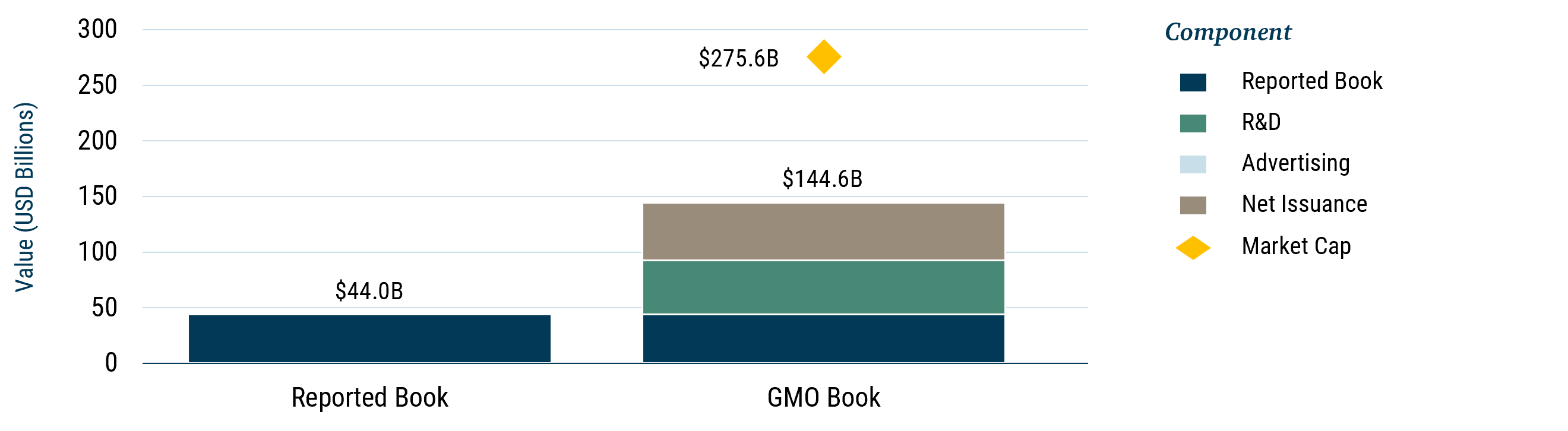
As of 3/31/2026 | Source: GMO
GMO Economic Book Value is the foundation for our valuation and quality assessments. Our Price to Fair Value model does what a rigorous fundamental analyst does, but at scale: project revenues, margins, and reinvestment decisions; assess business quality and profitability; estimate fair value; and compare it to the market price. We begin with the current GMO Economic Book Value and forecast a likely profitability path using company-specific predictors.
Exhibit 3: GMO's Price to Fair Value model
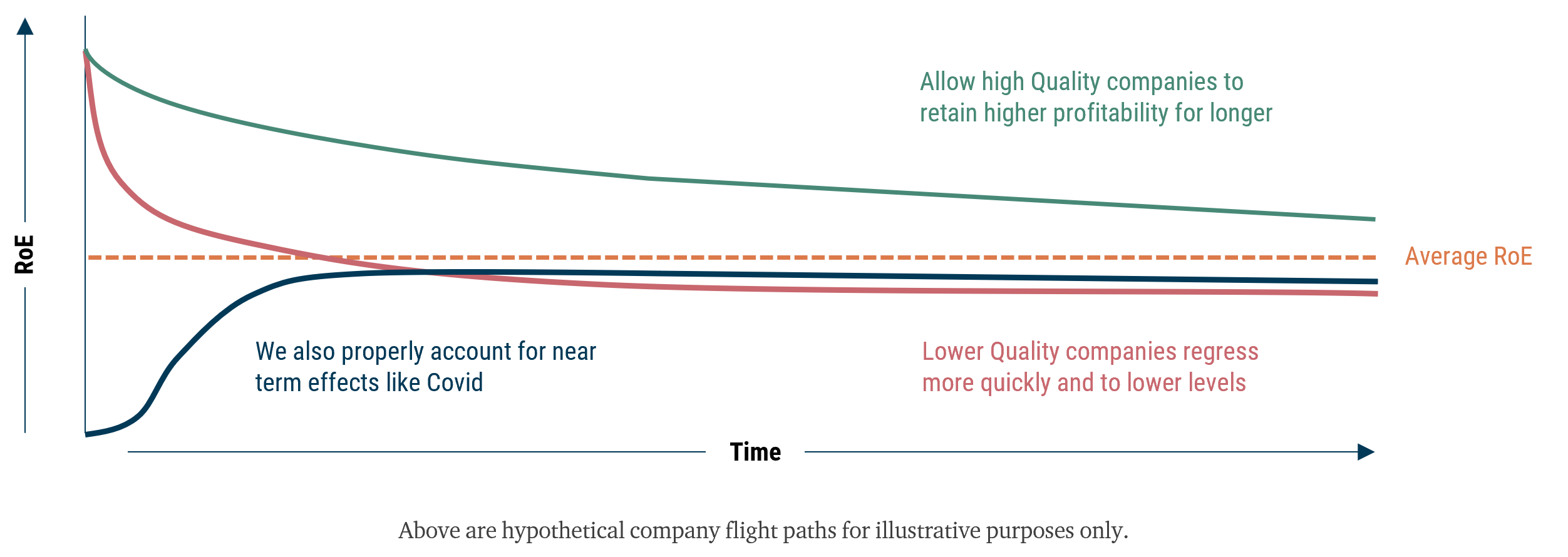
Within this framework, the model must reflect each company's own strengths and weaknesses. Cheapness alone is not a signal. A deteriorating business can screen inexpensive for years without ever rewarding patient capital. In contrast, a durably profitable business at a modest discount can compound above-market returns far longer than consensus expects. Our models capture these differences and distinguish between naïvely cheap and attractively valued, so portfolios own the second and avoid the first.
While valuation has always been at the core of our investment philosophy, we recognize the need for multi-dimensional alpha drivers. For example, our Alerts framework detects suspicious corporate behavior, red flags that often precede value traps, using market, management, and accounting data. We continue to enhance this suite of signals to help identify the names to avoid. We also utilize Momentum signals to reflect fundamental trends and how investor expectations evolve over time.
Keeping our edge sharp
Research is the mechanism by which conviction becomes an edge. The common thread across our current agenda is consistent: close the gap between fundamental and quantitative investing while keeping every decision traceable.
Five current initiatives reflect that agenda:
Exhibit 4: Current research agenda
Initiative |
What it adds |
| Lifecycle modeling | Context-aware signal weighting by company stage |
| Country - Industry signals | Framework for country x industry intersection |
| Transaction cost model | Model implementation calibrated to GMO trading experience |
| Uncertainty optimization | Resilience across plausible outcomes, not a single point estimate |
| Super Analyst | Deploying GenAI to add qualitative depth to quantitative breadth |
An early-stage business, a mature cash generator, and a late-stage company should not be judged by identical signal weights. Consider Lifecycle as an illustration, our research aims to enhance the alpha model to emphasize Valuation, Momentum, and Alerts signals when each is most informative, differentiating between higher growth, mature compounding, and later stage retrenching companies.
In papers to follow, we will be sharing more on the components of the process to highlight the uniqueness of our approach.
An edge that compounds
The GMO Systematic Equity team has delivered strong outcomes across a broad range of long-only and long-short strategies spanning U.S., international, emerging, and global universes. What unites them is not a single benchmark or style; it is a single research engine grounded in economic reality, applied with discipline for over four decades, that delivers transparent, high-conviction portfolios designed to outperform across multiple market cycles.