
Listen to this Insight
Introduction
Electricity demand is surging all over the world. To meet this demand, vast investments in power generation need to be made, and grids need to be overhauled and expanded. Ramping up electricity generation and delivery is extremely expensive, and electricity prices have spiked up throughout much of the developed world. All of this creates opportunities for investors across a wide variety of industries.
The Problem: The Era of Flat Electricity Demand Is Over
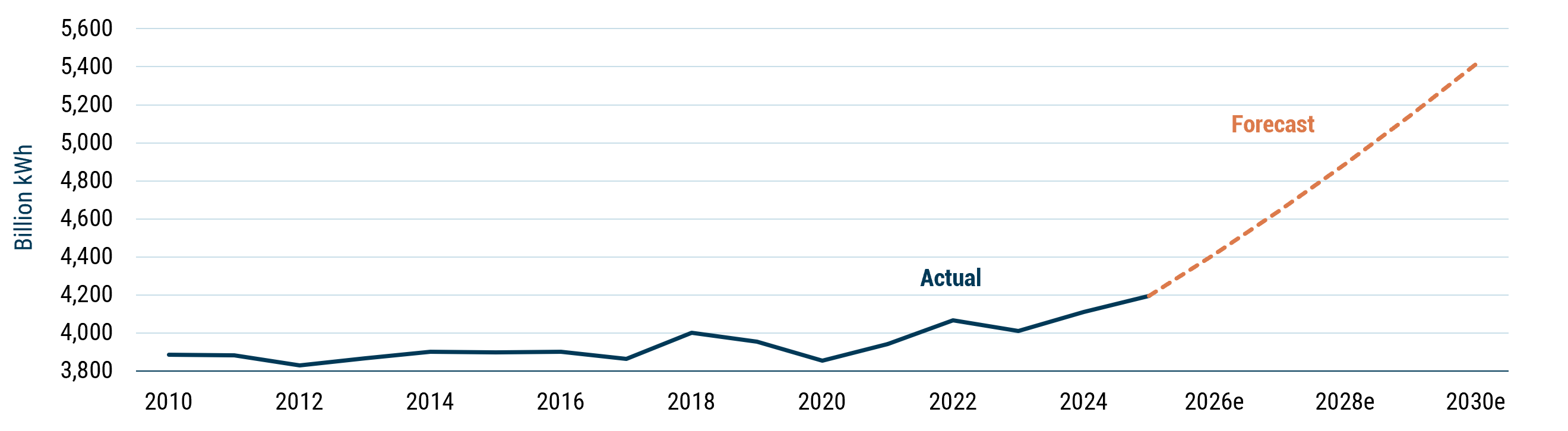
For most of the last couple decades, U.S. electricity demand was relatively flat. Pockets of demand growth were offset by energy efficiency gains. In the last few years, however, booming demand has overwhelmed the mitigating effect of energy efficiency efforts, leading to growing power needs (Exhibit 1). Utilities and industry experts expect even more robust growth over the next few years.
Exhibit 1: U.S. Electricity Demand, 2010–2030
Source: EIA historical data and Grid Strategies forecast as of 2025.
Data Centers the Size of Cities
Not surprisingly, AI and data centers are at the heart of things in the U.S. When you look at the scale of the data centers that are being built, it’s not hard to see why. Meta’s Hyperion AI data center, under construction in Louisiana, will be the size of a major city (Exhibit 2). What’s more, the data centers of the future are expected to be vastly more energy-intensive than those of today. NVIDIA recently noted that their new Blackwell architecture increases power demand “from tens of kilowatts to well over 100, with a megawatt [1,000kw] per rack now on the horizon.” 1
Exhibit 2: Hyperion Data Center over Manhattan

Source: Meta, NVIDIA
Beyond AI
Electricity demand is being driven by far more than AI, though. Non-AI data centers used for cloud computing and other data storage and processing tasks comprise much of the growth, as do electrification (EVs, heat pumps, electric hot water heaters, etc.) and increased industrial and commercial usage.
In fact, data centers (AI and non-AI combined) are expected to drive less than 10% of global electricity demand growth over the next few years (Exhibit 3). In Europe, EVs are expected to be bigger drivers of electricity demand than data centers, and emerging market demand revolves more around economic development and infrastructure expansion. Just about every major development of the last 50 years has relied upon increased power usage (e.g., computers, the internet, cell phones, EVs, cloud computing, AI, robotics), and human beings will undoubtedly come up with inventive new uses of electricity in the future.
Exhibit 3: Share of Global Electricity Demand Growth, 2025–2030

As of 1/30/2026 | Source: IEA
Values for the 2025–2030 period are forecasts.
Higher Demand → Higher Prices
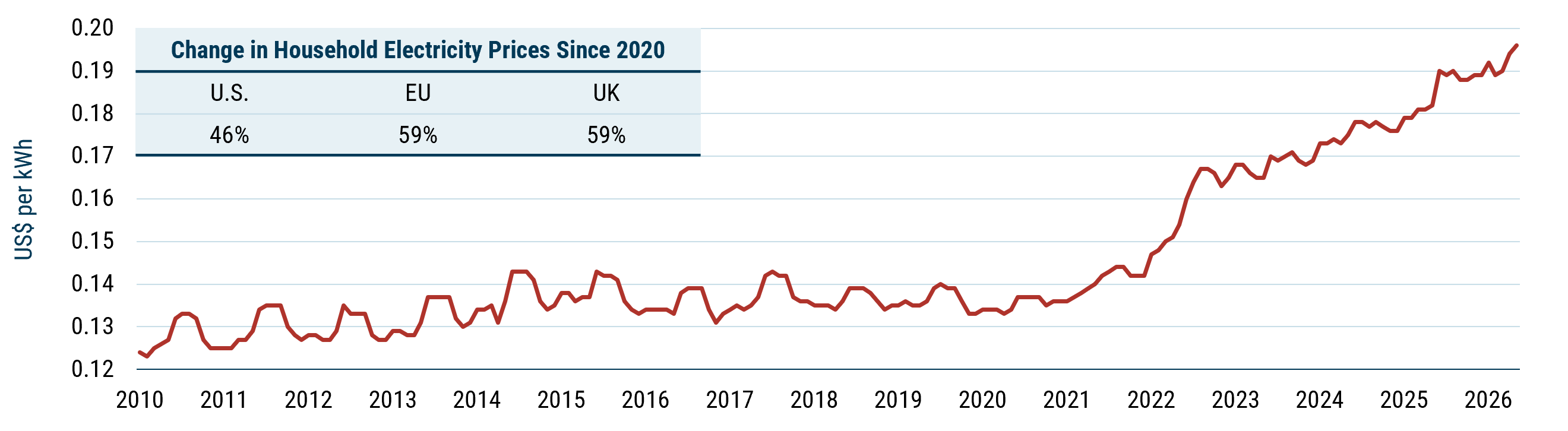
It should come as no surprise that the soaring demand has propelled prices higher. After years of flat electricity prices in the U.S., prices have shot up almost 50% since 2020 (Exhibit 4). In the UK and Europe, prices have risen even more. In many regions, decades of minimal investment left power grids strained even by the modest demands of the 2010s. With economic growth, data centers, EVs, and broader electrification pushing electricity use well beyond historic norms, utilities have been caught off guard on both the generation and the transmission and distribution (T&D) fronts.
Exhibit 4: Rising Demand Has Led to a Price Spike
Average Monthly U.S. Electricity Price
As of 5/31/2026 | Source: U.S. Bureau of Labor Statistics, Eurostat, UK Department for Energy Security, Net Zero
The Solution
There will be no simple solutions to addressing the rampant demand for electricity. Massive investments in power generation will be required. The grid will need to be expanded and modernized. Advancements in energy efficiency will be critical. And resources that underlie these efforts will be needed in quantities far greater than any historical precedent.
A variety of industries will benefit from this activity, and the resulting secular growth will create opportunities for investors willing to sift through areas long neglected by many.
The Next (Power) Generation
When it comes to new power generation, the options are limited. Historically, coal dominated global power markets, but outside China and India, coal isn’t much of a consideration these days. Natural gas is cleaner than coal, and in the U.S. and many other regions, natural gas is significantly cheaper as well. Consequently, many countries have been transitioning from coal to natural gas over the last two decades. As electricity demand surges and coal falls off, opportunities abound in the natural gas, nuclear, and renewables industries.
Unlocking U.S. Natural Gas
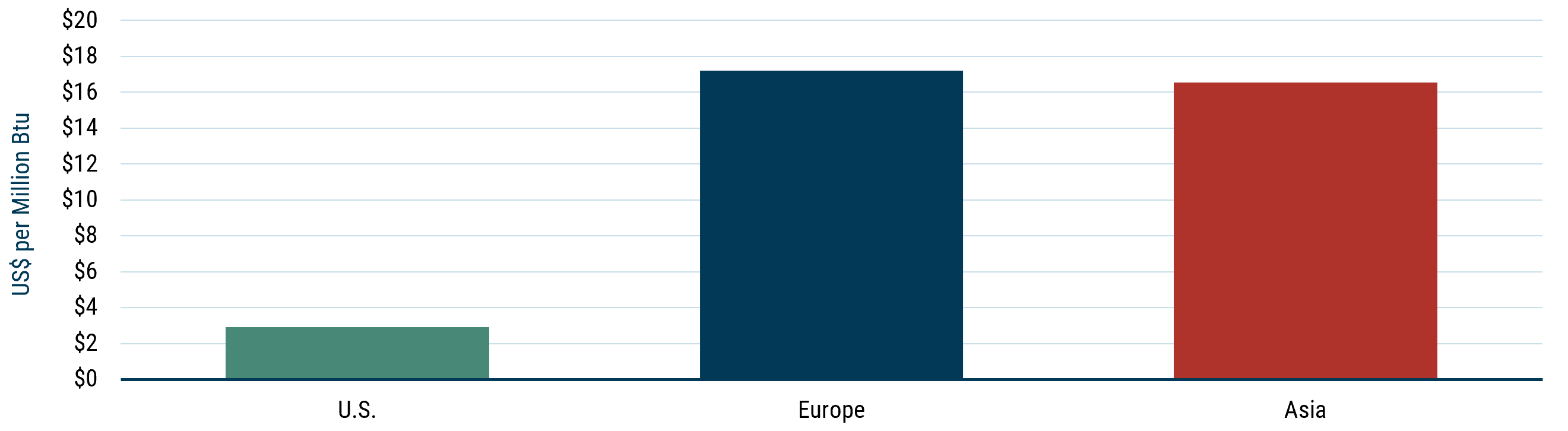
Spurred by the growth in electricity demand, the continuing transition from coal to natural gas, and a desire to replace unpalatable Russian and Middle Eastern supply, reliable natural gas sources are in high demand. The U.S. has a glut of natural gas due to the emergence of shale but limited export capacity. This has created a significant disconnect between U.S. and global prices (Exhibit 5).
Exhibit 5: GLOBAL NATURAL GAS PRICES
As of 7/13/2026 | Source: EIA, Bloomberg
U.S. natural gas price is Henry Hub. Europe is TTF. Asia is JKM.
Energy companies in the U.S. are seeking to take advantage of the substantially higher natural gas prices around the world by dramatically increasing liquefied natural gas (LNG) export capacity. Projects under construction will double U.S. export capacity, and approved projects could triple it. As new export capacity comes online, U.S. natural gas producers stand to benefit from selling at higher global prices.
Nuclear…No Longer a Dirty Word
The nuclear industry has experienced one of the more remarkable turnarounds in recent memory. Lumped in with tobacco and cluster bombs as commonly prohibited investments over the last two or three decades, nuclear has somehow emerged as an AI darling due to its ability to provide clean baseload power. The hyperscalers have all announced nuclear investments, ranging from the revival of Three Mile Island to the expansion of existing facilities to small modular reactors (SMRs). Nuclear has bipartisan support in the U.S., the European Union has reclassified nuclear as “green,” and dozens of countries have signed a United Nations pledge to triple nuclear capacity by 2050.
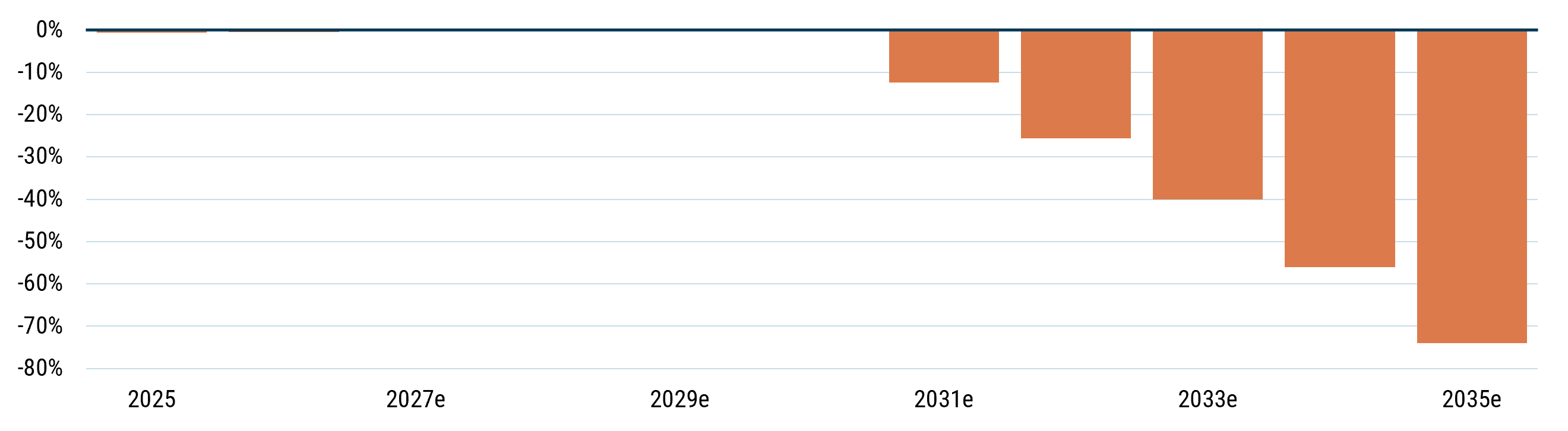
Even if a nuclear renaissance doesn’t come to fruition, uranium demand from existing and planned nuclear projects is projected to double by 2040. On the supply side, negative sentiment toward nuclear has led to decades of underinvestment in uranium production, and output from existing mines is expected to halve between 2030 and 2040. As a result, deficits are expected to be the norm in the uranium market as we move into the 2030s (Exhibit 6). This would clearly be bullish for uranium prices and, hence, producers.
Exhibit 6: Global Uranium Surplus/Deficit as a % of Supply
As of 7/11/2025 | Source: WNA, “World Nuclear Power Reactors & Uranium Requirements.”
Renewables Have Been Doing the Heavy Lifting
While natural gas and nuclear will have roles in the mix, neither are knobs that can be turned quickly. Natural gas turbines are sold out for the next few years, and you’d be lucky to get a nuclear project up and running within a decade. Renewables are cheap, clean, and readily deployable, making them strong candidates to fill the void. Despite the politicization of solar and wind in the U.S., renewables accounted for over 90% of power capacity additions last year (Exhibit 7), a continuation of dominance in recent years that extends globally as well.
The main drawback of renewables is their intermittency. Sometimes the sun shines, sometimes it doesn’t. To help address this, energy storage is increasingly being deployed as a standard part of solar and wind projects. The pairing of solar and wind with storage positions renewables to continue their critical role.
Exhibit 7: 2025 U.S. Power Capacity Additions

As of 3/31/2026 | Source: SEIA/Wood Mackenzie U.S. Solar Market Insight®
Electricity Must Travel
Of course, generating electricity is only part of the challenge. Once produced, electricity must be transmitted and distributed. Our grids are woefully unprepared for the challenge at hand. Most U.S. grid infrastructure was built in the 1960s and 1970s. Europe’s grid is even older, and emerging markets are still in the process of building out their grid in the first place. The grid needs to be expanded dramatically and modernized. We need a more efficient grid and one designed for the realities of the evolving energy landscape.
Our grids were designed around centralized, persistent generation and one-way flow to the end user. Now we’re adding distributed, intermittent generation to the puzzle, and energy flows bidirectionally (e.g., excess solar power flows from houses and businesses back into the grid). Increasingly, grids will rely on smart meters, sophisticated sensors, software, and data, providing a level of intelligence that utilities have been lacking. Many trillions of dollars will flow into grid services, transmission and distribution equipment, cables, software, and storage as grids grow and evolve to become more efficient and flexible.
Batteries and Storage: Not Just About EVs
One of the major enhancements to the grid will be the growing role of energy storage. Historically, energy storage didn’t exist in any substantive way beyond a pumped hydro project here or there. 2 Almost all electricity was consumed immediately. As mentioned, however, storage is increasingly playing a key role in addressing the intermittency of renewables. Battery attachment rates for solar projects have already risen from zero to 70–80%, and the amount of storage per project has been growing precipitously.
Beyond helping with renewables, storage plays a key role in operating the grid more generally. Supply and demand imbalances destabilize the grid and can cause grid collapse, as we saw last year when over 50 million people in Spain and Portugal were left without electricity for almost 20 hours. Storage makes life much easier for grid operators by acting as a buffer, meeting demand surges, and storing excess electricity.
Data centers are yet another developing source for storage demand. Data center electricity needs can spike up and down dramatically within seconds, depending on what they’re being asked to do. Imagine a grid trying to connect and disconnect a data center the size of Manhattan a few times over the course of a minute. Storage will be critical in managing these fluctuations. NVIDIA recently noted that due to volatile data center power demand, “energy storage must be treated as an essential, active component of the power architecture, not just a backup system.” 3
As recently as two or three years ago, the battery and storage industry revolved around EV batteries. Now, we’re seeing tremendous growth in energy storage systems (ESS) as well due to these emerging drivers (Exhibit 8).
Exhibit 8: Annual ESS Installations
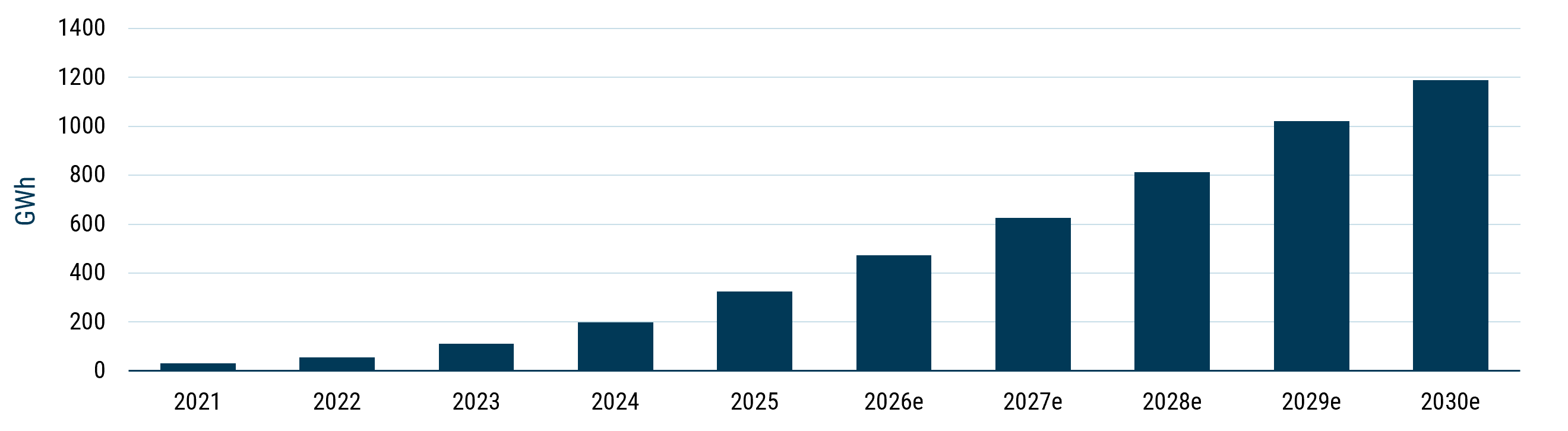
As of 6/30/2026 | Source: Morgan Stanley, GMO, Rystad.
You Can’t Do It Without Resources
Booming storage demand bodes well not just for battery and storage companies but also for the materials that go into batteries. Lithium batteries dominate the storage landscape, and given the unrelenting growth in ESS and EVs, lithium market deficits are expected in the next couple of years. Nickel and cobalt are other critical battery materials that will be in high demand.
We’ve also discussed natural gas and uranium, which underscores a key point. The future of energy will continue to rely on commodities. While the prominence of coal and oil will wane over time, the demand for other commodities will be far beyond anything we’ve seen before.
Much as oil has been at the center of the energy system we’ve built over the last hundred-plus years, copper will sit at the heart of the energy system we’re evolving toward. Many of the areas we’ve discussed—the grid, data centers, renewables, batteries, EVs, electrification—rely on heavy copper usage. Copper is another commodity where supply is expected to struggle to keep up with demand in the latter part of this decade, and large deficits are expected in the 2030s.
You Can Produce More Energy…Or Consume Less
In a world where electricity supply struggles to meet demand and prices rocket upward, energy efficiency solutions become both critical and financially attractive. Energy-efficient electrical equipment, appliances, transportation, and building materials can pay for themselves within a few years. Newer, more efficient HVAC equipment, for example, can offer payback periods of two years or less given the high prevailing electricity prices. Software, technology, and advanced automation can substantially cut electricity costs as well. Companies focused on efficiency will have tailwinds for the foreseeable future.
Conclusions
As the energy landscape evolves rapidly, countries that manage it well will accrue huge advantages. Consistent access to affordable energy provides economy-wide benefits, and countries that lead the electricity race will have a massive edge in AI. In recent years, the Ukraine and Iran wars have also brought the importance of energy security back to the forefront.
Energy may not be as exciting as AI or technology, but it is the foundation on which the entire economy is built, and tremendous investments will need to be made in that foundation. This will lead to growth in often-overlooked industries. Investors willing to delve into these industries have a chance to capitalize on the next energy boom.
Building the 800 VDC Ecosystem for Efficient, Scalable AI Factories | NVIDIA Technical Blog, NVIDIA Developer, October 13, 2025.
Pumped hydro involves pumping water uphill into a reservoir and then generating hydro power when it flows back down.
Building the 800 VDC Ecosystem for Efficient, Scalable AI Factories | NVIDIA Technical Blog, NVIDIA Developer, October 13, 2025.
Disclaimer: The views expressed are the views of Lucas White through July 2026 and are subject to change at any time based on market and other conditions. This is not an offer or solicitation for the purchase or sale of any security and should not be construed as such. References to specific securities and issuers are for illustrative purposes only and are not intended to be and should not be interpreted as recommendations to purchase or sell such securities.
Copyright © 2026 by GMO LLC. All rights reserved.
Building the 800 VDC Ecosystem for Efficient, Scalable AI Factories | NVIDIA Technical Blog, NVIDIA Developer, October 13, 2025.
Pumped hydro involves pumping water uphill into a reservoir and then generating hydro power when it flows back down.
Building the 800 VDC Ecosystem for Efficient, Scalable AI Factories | NVIDIA Technical Blog, NVIDIA Developer, October 13, 2025.