
Executive Summary
Amid a rapidly changing world, where China’s rise as an industrial powerhouse has nations around the globe on alert, we believe that American reindustrialization will be an important driver of investment returns in the decade ahead. Standard U.S. equity indexes are poorly positioned to capture the benefits of this generational opportunity due to their global, technology-heavy composition. We launched the GMO Domestic Resilience Strategy in October 2025 to give investors an actively managed solution to this problem and access a decade-plus investment still in its early stages.
“Not only the wealth; but the independence and security of a Country, appear to be materially connected with the prosperity of manufactures. Every nation, with a view to those great objects, ought to endeavour to possess within itself all the essentials of national supply.”
– Alexander Hamilton
Report on the Subject of Manufactures
December 5, 1791
American Manufacturing: A Brief History
Long before he was the subject of a hit Broadway musical, America’s first Treasury Secretary, Alexander Hamilton, urged his young nation to move beyond its agrarian economic roots to focus on manufacturing. The ability to make things, according to Hamilton, conferred two key pillars of national resilience: economics and security. The economic case for manufacturing was that it could provide employment, stimulate entrepreneurship, and create a domestic market for goods, enabling a virtuous circle of economic activity that benefited consumers, employees, and businesses. The security case was simpler: a country’s ability to defend itself was inherently linked with its ability to produce the weapons needed to do so.
Hamilton’s insight into the potential power of manufacturing more than 200 years ago proved prescient. Working in concert with steady technological improvements, manufacturing helped build the modern United States. In the 20th century, America’s resilient industrial base went global, providing its allies with an armada strong enough to win World War II and position the United States as a major global power for years to come. American-style prosperity became a major feature of the post-Cold War era starting in the 1990s. With communism defeated, the prospects for peace and prosperity seemed endless.
Yet, behind this favorable geopolitical backdrop, change was brewing. China’s entry into the World Trade Organization in 2001 would prove historic, but not for the reasons American leaders had hoped for. In the U.S., the decades-long link between manufacturing strength and economic growth began to break down. U.S. GDP growth remained strong, powered by technology and services businesses, but the country’s manufacturing base stagnated, as countless companies rushed to offshore production to cheaper locales, with China a particular beneficiary.
EXHIBIT 1: GROWTH OF U.S. GDP AND INDUSTRIAL PRODUCTION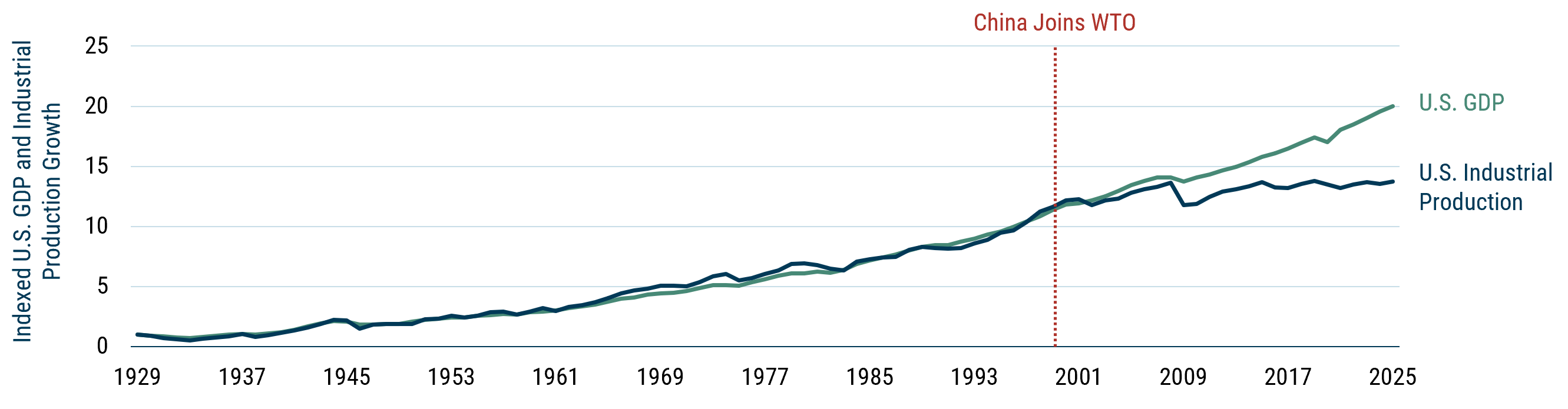
Data as of 2025 | Source: U.S. Federal Reserve, GMO
China’s rise as a manufacturer paired a genuine competitive advantage — ample low-cost labor — with seemingly endless state support. China provided manufacturers with cheap debt and loan forgiveness, direct grants, tax incentives, below-market real estate, subsidized electricity, preferred access to raw materials, weaker labor and environmental standards, and forced technology transfer from Western companies seeking access to the Chinese market. Finally, China showed a regular willingness to use international trading rules when it was to its national advantage, while ignoring them when it was not.
The Investment Case for American Reindustrialization
For investors, the important implication of this historical context is that the U.S.’s current position is somewhat precarious. While American consumers, as well as some companies and their investors, have benefited from cheap goods manufactured in China, this benefit came at the expense of the country’s industrial base, long a key economic and geopolitical advantage.
Whether you believe that China’s aims are global domination and military conflict, or that a rising China simply reflects an increasingly multipolar state of global order, one truth is clear: it’s not wise to have your major geopolitical rival also serve as your country’s manufacturer. The U.S. needs to reindustrialize.
Returning America to its Hamiltonian manufacturing roots will take time, but therein lies the investment opportunity. Amid a stock market that seems more short-term oriented each year, American reindustrialization offers an investment opportunity with an unusually long runway, at a time when many investors’ focus is elsewhere.
The Three Fundamental Forces Driving American Reindustrialization
American reindustrialization is a long-term process in its early stages, but there is evidence that momentum is building. We believe three fundamental forces are working in concert to revive America’s industrial economy
#1: Public Policy
In a fractured U.S. political climate, one thing even partisans can agree on is that Donald Trump’s surprising 2016 election victory put a spotlight on an area that needed attention: the U.S.’s declining industrial base. While tactics differ among political parties, legislation in the last decade under both Democratic and Republican administrations has included a healthy dose of policy aimed at rebuilding America’s industrial base, making reindustrialization a rare bipartisan issue. From the CHIPS Act and the Inflation Reduction Act under President Biden to the One Big Beautiful Bill in President Trump’s second term, American reindustrialization is a line that runs through both major political parties.
Tactical measures such as tariffs protecting the domestic steel industry were initiated in President Trump’s first term and maintained under President Biden. Under both Administrations, Congressional appropriations for increased defense spending, particularly in areas such as military shipbuilding, have received repeated bipartisan support. And under both parties, export controls focused on key technologies such as advanced semiconductors have been a common policy tool.
#2: Corporate Policy
American corporations led the movement toward offshoring over the last several decades. They added incredible levels of complexity to their supply chains, justified by the apparent cost savings of overseas manufacturing. The COVID-19 pandemic experience, however, called that assessment into question. Amid repeated lockdowns in China that left goods stranded, corporations learned an important lesson: if you go to China for cheap goods but aren’t able to get them out of the country when you need them, you don’t have cheap goods, you have no goods. The COVID experience kick-started conversations across corporate America about supply chain security, with terms such as “reshoring” and “friendshoring” reflecting a common motivation to improve supply chain resilience by manufacturing closer to home.
In the years since COVID, a number of geopolitical events have reinforced this reasoning. The Russia-Ukraine and Middle East conflicts have raised energy costs and caused expensive re routing of shipping lanes. Volatile tariff policies under the second Trump Administration have further whipsawed the corporate calculus. Export control battles over goods ranging from rare earths to semiconductors add another risk element. For corporations, the common trait amongst all this volatility is that the safest way to minimize its impact is to manufacture more in America.
#3: Defense Policy
China’s rise as a rival to the United States is not being taken lightly by the American military. The U.S. defense sector has a long and strong historical relationship with industrial America. China’s domination of the supply chain for the key rare earth elements necessary for a wide range of defense applications was cause for alarm. Its willingness to use this supply chain leverage as a geopolitical chokepoint spurred a host of responses from the U.S. defense community, ranging from stockpiling key resources to ramping up production capacity in key technologies such as missiles, drones, and autonomous weapons to developing novel commercial agreements to attract new entrants into the U.S. defense sector.
We believe the combined power of U.S. public, corporate, and defense policy will have a slow but significant long-term impact on America’s industrial capacity. Each represents an important change relative to recent decades’ thinking and sets in motion important forces moving in the same direction.
The Problem: The U.S. Equity Market is More Global Than Ever
For U.S. equity investors, the past decade’s geopolitical shifts have largely been a non-event. Fueled by growth in technology companies, America’s most well-known equity index, the S&P 500, has been on a tear, posting returns of nearly 15% per annum in the decade ending in 2025. Investors hearing the case for American reindustrialization might understandably think, “Sounds great, I have lots of U.S. equity exposure.”
The problem with this reasoning is that the composition of the U.S. equity market has changed considerably over time. The S&P 500, upon closer examination, is remarkably global. Less than 60% of the revenues of companies in the index come from the U.S., a figure that has been in steady decline for years as globalization has advanced.
EXHIBIT 2: THE GLOBALIZATION OF S&P 500 SALES AND REVENUE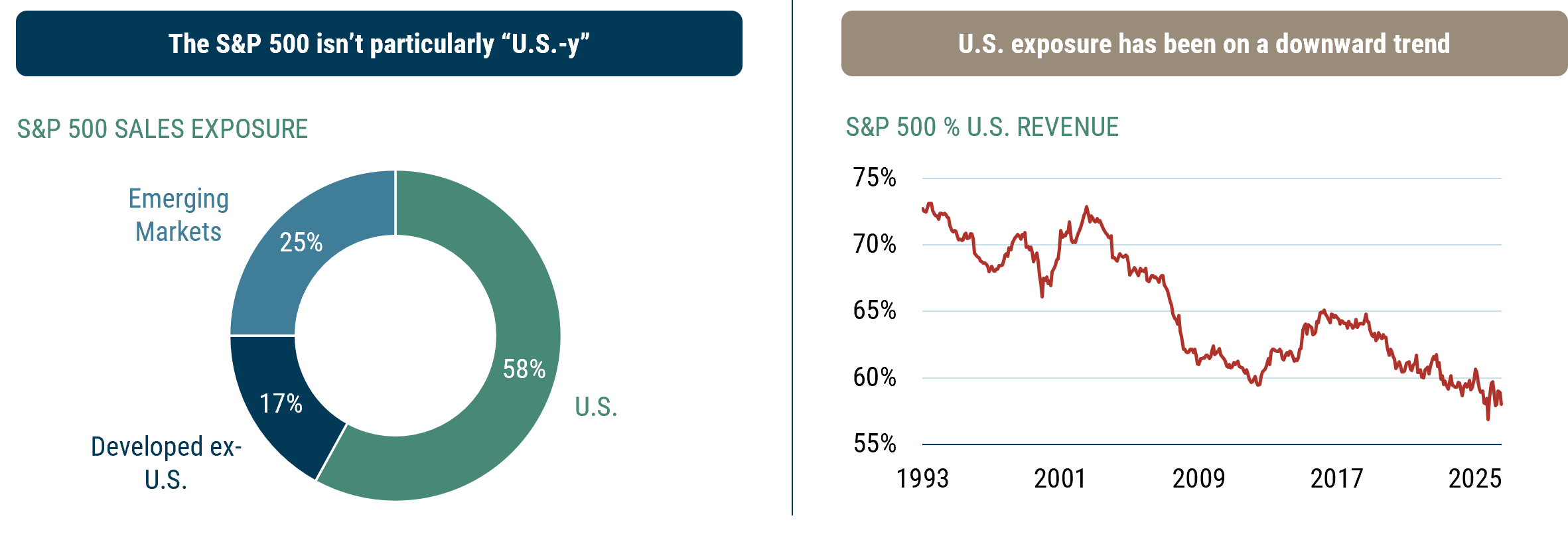
As of 6/30/2026 | Source: S&P, GMO
An investor who bought the S&P 500 seeking merely to be a “passive” owner of American companies saw their holdings become less U.S.-focused each year. And this increase in non U.S. revenue coincided with rising supply chain complexity as companies spread production around the world.
Growth in the technology sector has been led by some truly excellent companies, but the result has been a crowding-out effect in the U.S. equity market, where companies that form the industrial backbone of the American economy now represent a smaller-than-ever slice of the pie. As recently as the late 1990s, the GICS Industrials, Energy, and Materials sectors together accounted for more than 25% of the S&P 500. Today, their cumulative weight is less than 15%.
EXHIBIT 3: INDUSTRIALS, ENERGY, AND MATERIALS SECTORS COMBINED WEIGHT IN THE S&P 500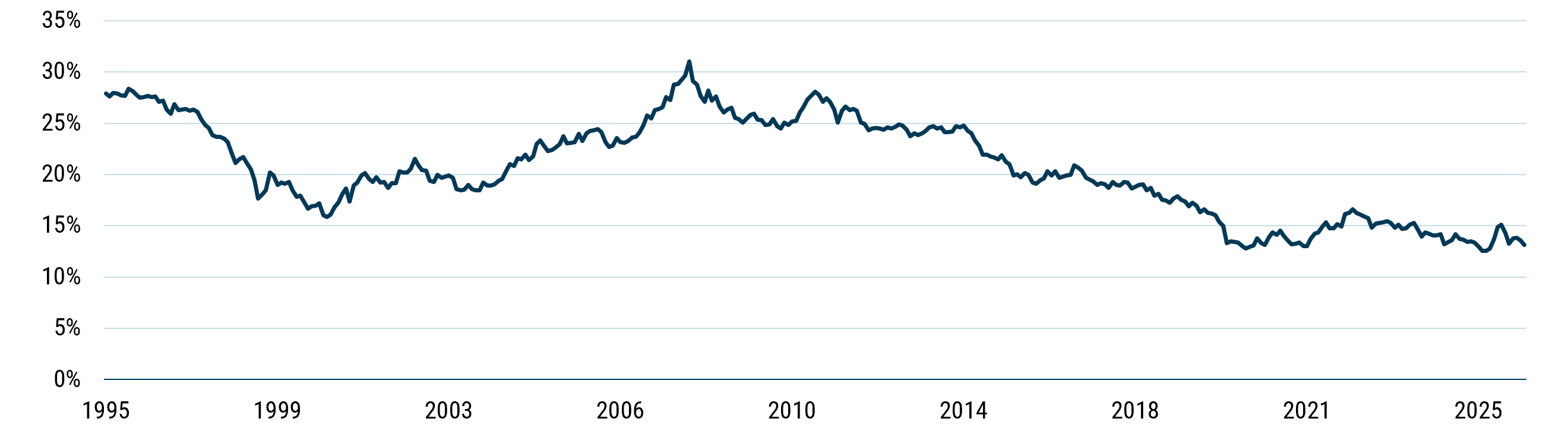
As of 6/30/2026 | Source: S&P, GMO
While the trailing returns of the U.S. stock market have been strong, the effect has been to leave indexes like the S&P 500 historically light in the types of companies that stand to benefit most directly from American reindustrialization.
The Solution: Domestic Resilience
Seeking to solve this investment problem, we surveyed the available options and came away unimpressed. Many strategies offering solutions were too broad or too global. Few considered company valuation to be an important driver of investment returns. Eventually, we came to an important conclusion: we needed to build our own. We named our strategy Domestic Resilience, reflecting our focus on the types of companies that we believe are core to America’s industrial strength.
To build Domestic Resilience’s investment universe, we developed a framework to think about the types of companies we wanted to own. We considered American reindustrialization as an option, something investors would receive in addition to a company’s current earnings trajectory. We wanted Domestic Resilience companies to be in businesses where the size of this option could be significant, a meaningful long-term earnings growth tailwind. We found that companies fitting the reindustrialization optionality framework fit into one of four categories, which we detail below:
EXHIBIT 4: DOMESTIC RESILIENCE INVESTMENT FRAMEWORK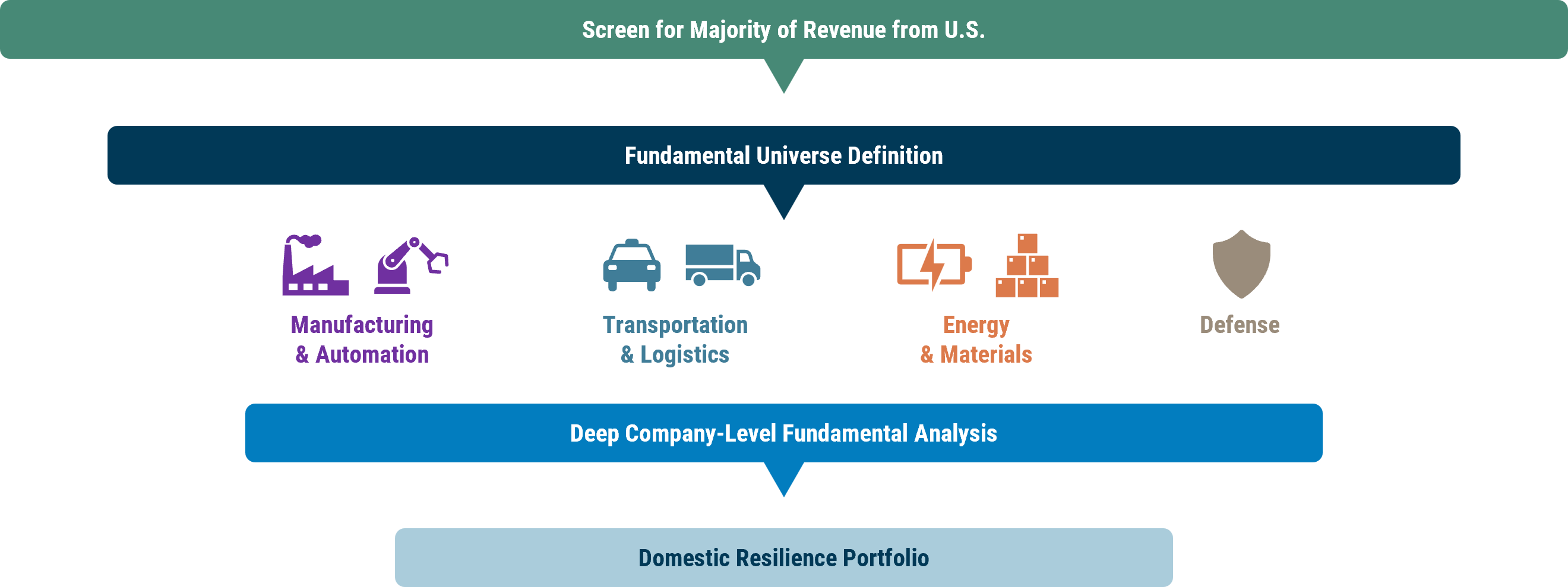
Source: GMO
Manufacturing & Automation
Manufacturing & Automation is an intentionally broad category because it captures a wide variety of companies with exposure to the American industrial economy. Examples include engineering and construction firms like Jacobs Solutions and Fluor that build everything from manufacturing plants to bridges to data centers. Equipment rental companies like United Rentals provide the tools needed to build. And automation firms like Rockwell Automation enable U.S. companies to use capital to increase manufacturing capacity in industries where labor is scarce.
Transportation & Logistics
More U.S. manufacturing activity means more domestic transportation activity. Companies in the trucking and railroad sectors are natural beneficiaries as America moves from a system in which finished goods are shipped across the ocean to one in which manufacturing is done across countless nodes on the U.S. map. Companies like Union Pacific, the country’s largest railroad by track mile, and Knight-Swift, America’s largest truckload company, represent the types of market leaders poised to benefit from reindustrialization-driven growth. The U.S. has a robust transportation infrastructure, and reindustrialization will take full advantage of it.
Energy & Materials
Energy and Materials can be simply thought of as the stuff you need to build other stuff. The products themselves - oil, natural gas, aggregates, and others – are boring and generally thought of as commodities. But you can’t build much without them. And while the product itself is interchangeable, its availability is limited. The world doesn’t have an endless supply of these materials, especially in locations near industrial production.
That’s why Domestic Resilience focuses on oil and natural gas companies like ConocoPhillips and EQT and key industrial minerals providers like Martin Marietta and Vulcan Materials that have the bulk of their assets in the U.S. Many domestic energy and materials companies have gotten better over time at understanding the scarcity value of what they produce and where they produce it, raising the prospects for good future shareholder returns earned providing these essential inputs to growth.
Defense
Industrialization and the U.S. defense sector have often had closely tied fates. The need to promote peace through strength in a changing world is central to defense’s role in America’s reindustrialization. Prime contractors such as Northrop Grumman and Lockheed Martin have a long history of providing defense solutions for the U.S. and its allies. Leading military shipbuilder Huntington Ingalls similarly draws on decades of experience to inject new energy into an industry that had become stagnant. With kinetic conflict increasing around the globe, technology changing the nature of warfare, and China’s military growth on the rise, defense companies represent a crucial pillar of the American industrial base.
Selecting Stocks: The Importance of Value and Quality
A final principle that we believe differentiates Domestic Resilience’s investment approach from index-based or other similar thematic strategies is our stock-selection process. While many investors focus on a “Noah’s Ark” strategy for security selection, owning a little bit of everything, our approach is more focused. Two principles guide Domestic Resilience’s security selection: quality and value.
Quality
American reindustrialization is an exciting concept and is likely to attract considerable investor attention in the years to come. Against such a backdrop, some might adopt a “gold rush” strategy, seeking the perfect plot of land to mine. Our approach is conservative by comparison. Rather than trying to perfectly guess the particulars of how reindustrialization plays out, we prefer “picks-and-shovels” business models that will benefit from industrial growth wherever it occurs. The picks-and-shovels framework reflects our belief in the importance of company quality in selecting investments. Companies with strong business models and durable moats against competition enter the prospect of American reindustrialization with a considerable advantage, combining the business and financial strength necessary to capitalize on the long-term opportunity while weathering the inevitable bumps along the way.
Value
We also believe that the price you pay for an investment significantly affects future returns. In many of history’s major investment trends – from the railroad boom to the advent of the Internet – investors who cast aside valuation concerns often ended up disappointed. As we survey Domestic Resilience’s investment universe, we focus on understanding each company’s prospects and determining the appropriate price to pay for its growth potential.
Doing so positions us to capture investment returns commensurate with the company’s business growth without the drag of paying too high a price. Valuation also serves as a risk mitigation technique, as securities priced for perfection are often prone to underperformance if things don’t go exactly as planned. By focusing on valuation, we can increase our chances of owning companies with upside if things go well and a helpful cushion if they falter.
An Active Approach
Our valuation focus also underscores a key advantage that Domestic Resilience brings to the market compared to passively managed alternatives. Rather than simply owning small positions in a large number of companies and hoping for the best, our active approach can capitalize on near-term valuation opportunities, rotating the portfolio toward companies and segments of America’s industrial economy that we believe can offer the biggest bang for our buck at any given time.
With today’s equity market investors heavily focused on companies with exposure to Artificial Intelligence (AI), we currently find the best valuation opportunities in industrial America to be in companies whose exposure to the AI buildout is limited or indirect. But that may not always be the case. Our focus on valuation, combined with an active approach, gives us the flexibility to navigate these changing times.
Conclusion: Have Some Atoms with Your Bits
The combination of a technology-heavy U.S. equity market and shifting geopolitical forces has created an important decision for investors. We believe that companies in America’s industrial backbone stand poised to benefit as the multi-decade headwind of offshoring manufacturing turns to a tailwind. By understanding history and applying time-tested investment principles, we believe Domestic Resilience offers a useful tool for investors seeking to navigate a future that differs from the recent past.